

Products


LED Hexagonal Garage Lights
Most garages do two jobs. They park a car and they host work. A led hexagon lights garage array that only lights the car leaves the bench in shadow, so this twelve-module kit is split into an eight-module car zone and a four-module bench zone, fed from one ceiling point.
Features
PRODUCT 09 / TWO-ZONE DUAL BAY
Led Hexagon Lights Garage
12 Modules · Two Zones · One Feed
Most garages do two jobs. They park a car and they host work. A led hexagon lights garage array that only lights the car leaves the bench in shadow, so this twelve-module kit is split into an eight-module car zone and a four-module bench zone, fed from one ceiling point.
SEND YOUR BENCH POSITION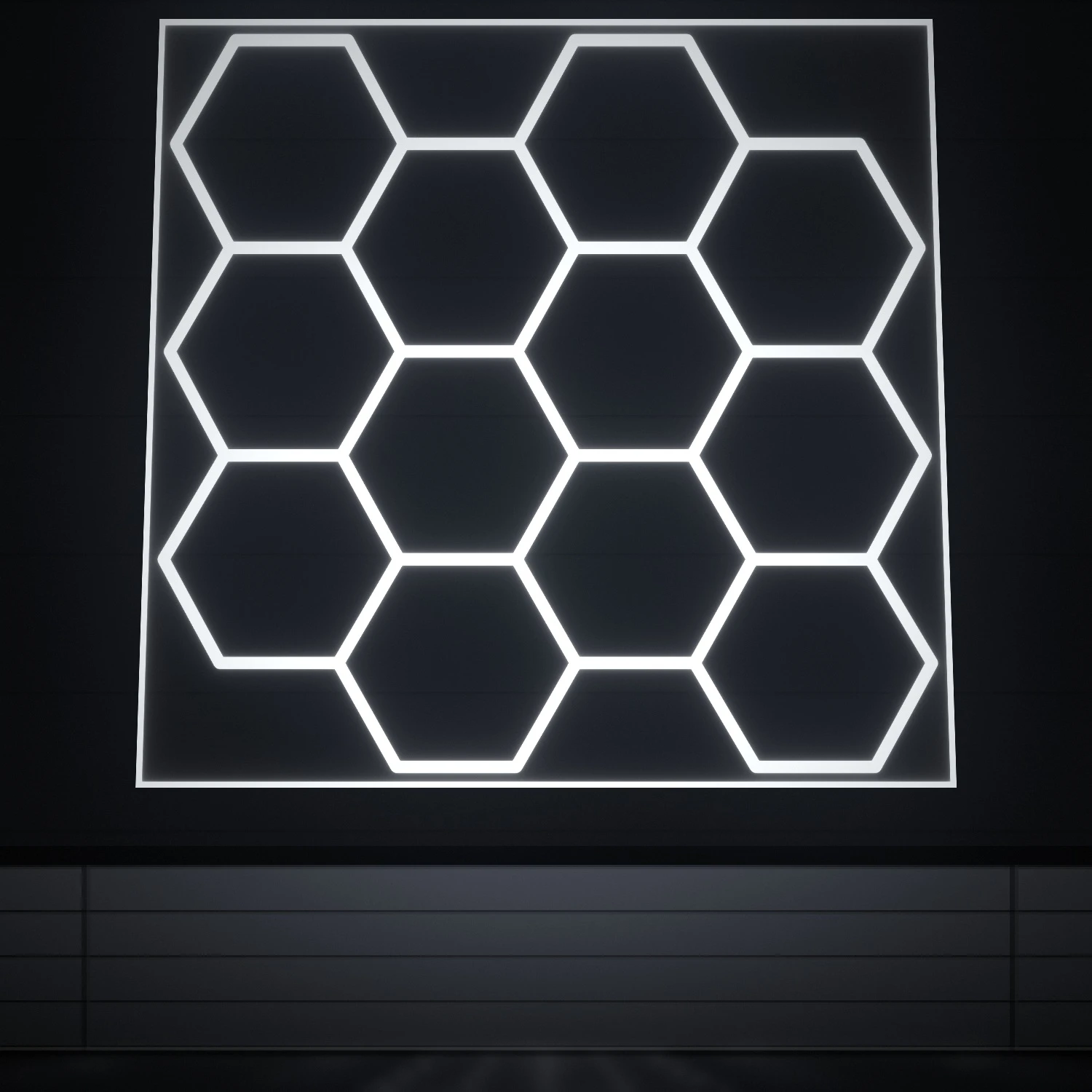
Twelve modules over a two-car bay: four columns follow the length of the cars, and the back row is reserved for the workbench.
A Garage Is Two Rooms in One
Park a car in it and the room needs soft, even light: enough to see the tyres, the floor drain and the corner of the door, not so much that the paint turns into a mirror. Take the car out and the same room becomes a workshop, where the demand changes completely. You need light that arrives from the side, lands on the workpiece and does not put your own shadow across what you are doing.
One uniform grid cannot serve both. If you size the whole ceiling for workshop light, parking under it feels like standing in a light box. If you size it for parking, the bench stays dim and every small job moves to the driveway. The practical answer is not more modules everywhere - it is two zones with two jobs, sharing one supply.
That is what this kit is built around. Eight modules sit over the cars. Four modules sit over the bench. The split is decided before the tubes are cut, because moving a zone after the ceiling is finished means new fixing points and a new cable run.
Why Eight Plus Four, Not Three Times Four
A symmetrical 4 × 3 block looks tidy in a rendering and behaves badly in a real garage. It puts the same amount of light over the middle of the bay, where the roof of the car already reflects it, and almost nothing over the bench at the back wall, which is where the detail work happens. Symmetry is a drawing habit, not a lighting plan.
Eight modules in four columns of two cover the working length of two parked cars without stacking light on the bonnets. The remaining four run as a single row along the bench wall. The row is deliberately narrow: a bench is 600 mm to 750 mm deep, and four modules at 60 cm tube length give a band that lands on the bench top and the wall behind it, not on the middle of the floor.
If your bench runs along a side wall instead of the back wall, the row rotates with it. The module count does not change; the drawing does. That is the whole reason we ask for a plan before quoting a price.

Zone A covers the cars at 200–300 lux. Zone B covers the bench at 500–750 lux. Both hang from the same run.
Put the Bench Light Forward of Your Hands
The most common mistake in a home workshop is hanging the light directly over the bench. It feels logical and it fails immediately: you stand between the light and the work, and your own body throws a shadow exactly where you need to look. Every time you lean in, the shadow leans in with you.
Move the row forward - toward the room, away from the wall - by 300 mm to 450 mm from the front edge of the bench. Light then arrives over your shoulder at a steep angle, hits the bench top and the wall, and your hands cast their shadow backwards, behind the work, where it does no harm.
The same logic applies to where you stand. If you work from the end of the bench rather than the front, the row should sit off that end. Send us a photo with a broom handle laid where you usually stand; that single image settles the geometry faster than any dimension.
Height matters too. A row at 2.4 m spreads wide and soft; a row at 1.9 m concentrates the light but starts to glare when you look up. For a bench against a back wall, 2.1 m to 2.4 m above the floor is the usual compromise.
One Feed, Two Switch Legs
The two zones share a single supply and a single run of modules. The modules plug into each other through short link cables, so there is no junction box above every hexagon. What separates the zones is not a second cable to the ceiling - it is a second switch leg at the wall.
In practice the ceiling feed lands in one driver, and the driver output is split at the wall into two switched legs. One switch runs the eight car modules, the other runs the four bench modules, and a third position runs both. No dimmer is needed: switching is cheaper, more reliable and easier for an electrician to certify than a dimmed circuit.
Choose the voltage when the order is placed. AC 110V for the United States and Canada, AC 220V for Europe, the Middle East, Africa, Australia and most of Asia. The driver is fixed at build, not switchable on site, and the plug follows the destination.
The link cables between modules are plug-in and can be handled by the installer. The fixed connection at the ceiling is not a DIY step - a licensed electrician should make it and confirm the circuit.
Read Lux, Not the Number on the Box
Three figures decide whether a garage feels right. On the floor, between and around the cars, 200 to 300 lux is comfortable for parking and cleaning. On a bench top, 500 to 750 lux is where small parts and fine marks become visible. Where paint defects are judged, 750 lux and above is the working range.
The 12-module class is commonly listed between 210 W and 280 W and between 23,000 lm and 30,800 lm. Those totals mean very little on their own: a wide array at 2.4 m and a tight array at 1.9 m can share a lumen figure and deliver completely different light on the bench. The drawing and the mounting height decide the result.
Colour rendering matters more in a garage than most buyers expect. A grey primer looks grey under Ra > 90 and slightly green under a cheap 80. If the bench is for paint, electrical work or detailing, specify the higher grade and 6500K. For general repairs, Ra > 80 at 5000K is easier on the eye over a long evening.

Extruded aluminium with a push-fit corner joint and a short link cable. The run is continuous - one feed, no junction boxes between modules.
Hang the Bench Row First
Hanging a led hexagon lights garage array in two zones is mostly a question of order. Start with the four bench modules, because that row is tied to a fixed object - the bench - and its position is easy to check with a tape. Get that line right, then measure the car zone off it. Doing it the other way round means re-checking two references instead of one.
Mark the two long centre lines, fix the clips along them, then lift the rows into place and plug the modules together. The frame is light enough to handle with two people and awkward enough that one person should not try. A telescopic prop helps, but it does not replace a second pair of hands on a 2.4 m row.
Power the run before the ceiling is closed and before anything is parked underneath. A dead module is a two-minute connector check while the run is open; after the ceiling is finished it becomes a return conversation. The typical assembly time for twelve modules is three to four hours with two people, not counting the electrician's supply.
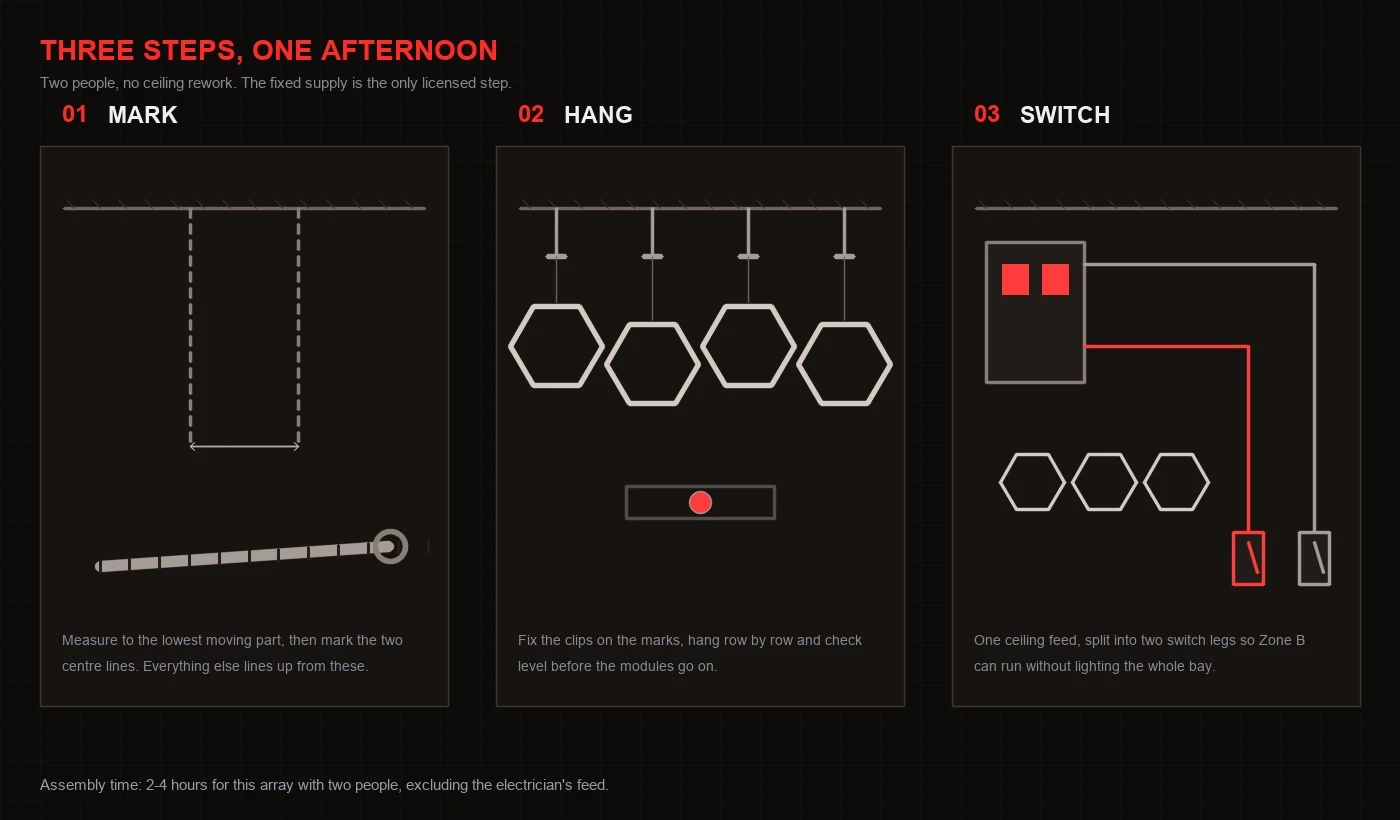
Mark, hang, switch. The bench row goes up first, the car zone is measured off it, and both zones share one ceiling feed.
Drawn Around Your Bench, Not Our Catalogue
Every led hexagon lights garage kit we ship starts as a drawing of your room. Send four things and the drawing comes back: a wide photo of the ceiling, the height from the floor to the lowest moving part, the length and depth of the bench with the side you stand on, and the width of the two cars.
From those we return two or three options with the zone split marked, the module count, the wattage, the fixing points and a bill of materials. If the bench is on a side wall, or the room has a structural beam, the array is split or stepped rather than forced into a rectangle. You pick one; we cut to it.
The layout is free and no invoice is raised before you sign it off. What we cut to order: tube length, profile colour, colour temperature, CRI and plug type. What is not custom is the physics: the bench row still has to sit forward of your hands, and the driver still has to be sized for the final count.
Specification
| Module configuration | 12 hexagon modules - 8 car zone + 4 bench zone |
| Array footprint | Approx. 3.9 × 3.8 m at 60 cm tube length; confirmed on the drawing |
| Tube length | 44 cm / 60 cm / 120 cm |
| System power | Typically 210–280 W for this class - final figure on the drawing |
| Luminous flux | Typically 23,000–30,800 lm - confirmed with driver and tube count |
| Target illuminance | 200–300 lux car zone; 500–750 lux bench zone |
| CRI | Ra > 80 standard; Ra > 90 optional |
| Beam angle | 180° |
| Colour temperature | 3000K / 4000K / 5000K / 6500K; 2000K–6500K custom |
| Input voltage | AC 110V or AC 220V - fixed at order |
| Control | One feed, two switch legs (car zone / bench zone / both) |
| Material | Aluminium profile with PC diffuser |
| Profile colour | Silver as standard; black anodised to order |
| Mounting | Surface clips or steel wire suspension |
| Operating temperature | −20 °C to +45 °C typical; confirm for unheated garages |
| Certification | Documents for your market confirmed at quotation |
Power and flux figures are typical public values for 12-module systems in this class. Your exact wattage depends on tube length and driver choice, and it is fixed on the approved drawing.
Questions About Two-Zone Garages
I only have one switch at the door. Do I need to rewire?
Usually one extra leg is enough. If the wall is finished, a wireless switch module on the second leg avoids chasing the wall. Tell us at order stage and we match the driver to it.
Can I run the bench zone on its own all evening?
Yes - that is the point of the split. Four modules at 60 cm draw a fraction of the full array, so an evening at the bench does not mean lighting the whole bay.
My bench is on the side wall, not the back.
The four-module row rotates 90° and follows the bench. Send the bench length and the side you stand on; the drawing changes, the module count does not.
Will the two zones look like two separate lights?
Only if the rows are far apart. Keep the bench row within about one module width of the car zone and the ceiling reads as one assembly. We show this on the drawing before production.
Can this be split between two cars later?
Yes. The car zone runs in one continuous row set, so if a second car arrives the drawing is extended rather than rebuilt - provided the driver is sized for the final count at order.
Does a brighter module make the bench easier to work at?
Not on its own. Bench light is about direction and shadow, not raw output. A 750 lux row placed behind your hands is worse than a 500 lux row placed forward of them.
Send a Photo of Your Bench
One photo of the ceiling and one of the bench are enough to start. We come back with a two-zone layout over your dimensions, the module split, the wattage and a voltage-specific bill of materials - usually within one working day, free, whether the order is one kit or a container.
DIRECT LINE - NO FORM, NO WAITING
| Company | Henan Hanyin Industrial Co., Ltd |
| Brand | Hanyin |
| Contact | Lucy |
| Tel / WhatsApp | +86-183-37157058 |
| lucyjones@foxmail.com |
One working day for the drawing. No invoice is raised until you sign off the layout.
1. Are you a manufacturer or trade company?
We are the earliest manufacturer which designs and produces certain led workshop lights.
2. Do you do the OEM&ODM of LED light?
Yes, we can OEM according to your requirement and send you a draft drawing for your confirmation.
3. Can you make customized products for our projects?
Yes, the customized products are available, we can design for free and provide the auto CAD or 3D drawings for different projects.
4. How do we do the installation of LED lights?
Don't worry it's very easy, we have the manual for every product, also the customized manual for every customized product. Or our after-sales service people will guide you online.
5. How about the warranty?
5-years warranty! Any defective products within warranty will get maintenance or replacement.
6. How do you do the delivery?
We have long-term cooperated freight to help us to deal with the shipping, we can provide the shipping cost for your reference. Or you can deal with the delivery by our freight agent.
7. What is the lead time of the car detail LED light?
We have regular stock of LED lights that can deliver within 3~5 days. If there is a particular order, we can produce and ship it within 10 days.
Hot Tags: LED Hexagonal Garage Lights, China LED Hexagonal Garage Lights manufacturers, suppliers, factory, Hexagonal Grid Systems Car Detailing LED Garage Light, Car Workshop Detailing LED Working Light, DIY Plug in Hexagonal LED Ceiling Lights for Garage Light, LED Rectangles Lighting, Professional Car Wash Aluminum Hexagonal Light LED Work Light, led light for garage
You Might Also Like


Send Inquiry
